Apartmány Marlene

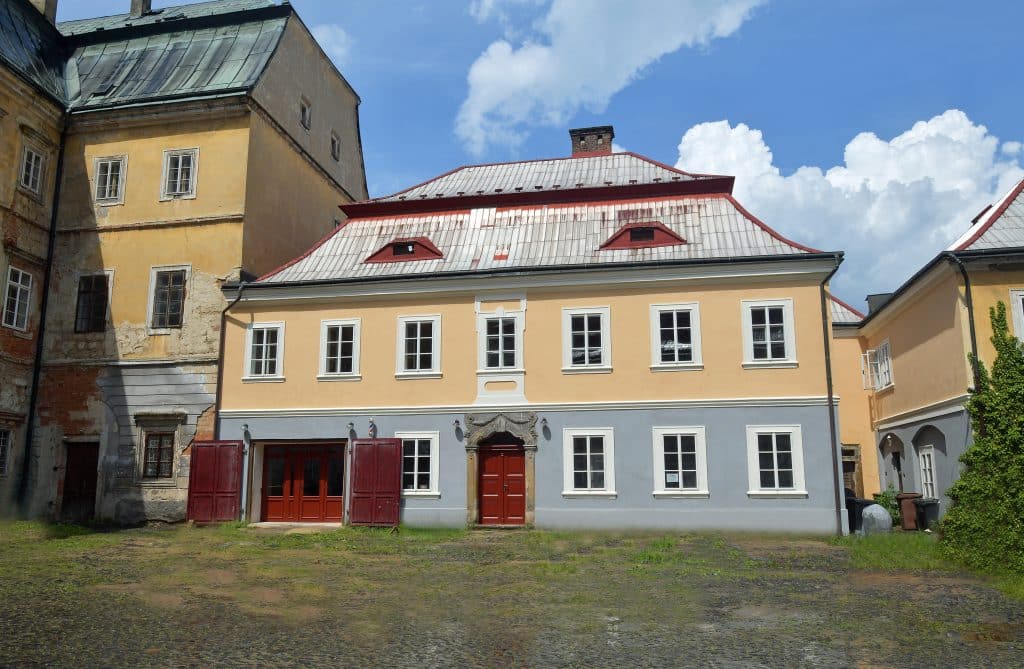
History of Česká Kamenice Chateau

History

The town of Česká Kamenice was founded at the intersection of two regional roads, the so-called “Czech Road” and “Lusatian Road,” probably in the area of an older Slavic settlement sometime in the 1270s during the reign of King Přemysl Otakar II (1253–1278). The first explicit mention of Kamenice in written sources dates back to 1352. Our town is referred to here as “Kamenycz oppidum” – the town of Kamenice with a parish church. More abundant written records are available from the end of the 14th century, when Jan III of Michalovice, also known as Michalec, was the lord of the town. It was he who issued the first written documents to the town.

In 1380, he confirmed the town book for the citizens of Kamenice – here we learn, for example, that the villages of Horní and Dolní Kamenice, Jánská, Oleška, Srbská Kamenice, Všemily, Jetřichovice, Vysoká Lípa, Rynartice, Chřibská, Lipnice, Líska, Kunratice, Prysk, Kamenický Šenov, and later Studený and Kamenická Nová Víska. Then, in 1383, he issued a legal document granting the townspeople the right of escheat.
In 1394, Jan Michalec sold the townspeople the rights to the spa, brewery pans, and goods brought to market for 70 kopecks. The town thus acquired important legal documents that became the basis for the rights of the inhabitants of the Českokamenice estate. The burghers took advantage of the financial difficulties of the nobility, who eventually sold the Šarfenštejn estate to Hynek Berka of Dubá (1405–1406). His descendant Jindřich ceded the estate to Zikmund of Vartenberg around 1428.

The Vartenberg family held the estate for many years, expanding the town’s freedoms and granting privileges – the town had a salt trade, weekly and annual markets. In 1492, Zikmund allowed the townspeople to sell beer in the surrounding villages. All this took place during the turbulent times of the Hussite Wars.
Česká Kamenice was repeatedly visited by Hussite troops – according to tradition, Jan Žižka also camped here under Sedlo Hill. In the 15th century, unrest was caused by the Vartenberg family, who clashed with the surrounding nobility, the Saxon princes, and especially with the union of Lusatian towns – the Six Towns (Bautzen, Görlitz, Zittau, Löbau, Kamenz, Lauban).

In 1444, this coalition, together with the people of Prague and Litoměřice, carried out a devastating expedition, burning down castles and Česká Kamenice, including the Church of St. James.

In 1511, the indebted Zikmund II of Vartenberg sold his entire estate to Mikuláš Trčka of Lípa, who soon transferred it to the Saxon Salhausen family. The Českokamenice part went to Bedřich, whose daughter Anna brought it back to the Vartenbergs around 1536 through her marriage to Prokop of Vartenberg. The estate remained in their possession until 1614, when it was sold to Radslav the Elder Vchynský of Vchynice and Tetov due to debts. The Kinský family then held the Českokamenice estate until 1945, when large estates were abolished after World War II.

Although the town suffered to varying degrees from the horrors of the Thirty Years’ War, devastating fires, and destructive floods, it continued to develop successfully. After the end of the war in the mid-17th century, there were approximately 236 houses in the urban agglomeration. The tax register from 1654 lists 6 deserted houses and only 1 burned house in Kamenice. A hundred years later, in 1757, there were already 323 houses, and by 1843 there were 451 houses, etc. Demographic data also show a fairly successful development.

For example, the population in 1713 was 1,782, and by 1843 it was already 3,215. The highest population was reached by the three Kamenice towns (Horní, Dolní, and the city) in the 1930s. In 1930, a total of 6,637 people lived here. Just for comparison, today (2008) a total of 5,523 people permanently live in the administrative territory of the town. The development of the textile and other industries also had a powerful impact on the further growth of the town in the 19th century.